
|
[NOTE: in order to read the notes please allow pop-ups for this site]
__________________
|
Chapter 2 - page 2The ragged clown has been around at least since the formation of the Commedia dell'Arte in the 16th century in Italy. It was here that the stock characters of comedy were standardized, each actor keeping his chosen character for life. The dialogue and much of the action in the Commedia dell'Arte was improvised around a skeletal plot, and clowns added dance, acrobatics, and juggling, as well as comments on current affairs. The familiar Harlequin (Arlecchino) began here as a clown who'd seen better days, his outfit covered in multi-coloured patches. He later acquired a better fitting suit with neat triangles of red and yellow. The beautiful, sad, white-faced Pierrot (Pedrolino) had his roots here before being adopted -- and changed in -- France. The bumbling, colourful Auguste began in Germany much later. The American Tramp and Hobo Clowns and Bag-Lady Clowns, later still. Alongside the well-known aristocratic clowns of the Commedia dell'Arte were the Zanni. They were a large group of clowns of varied appearance and with different dispositions. They were of the peasant class and played clever servants, quick with snide remarks, intrigue, and cunning but helpful to their masters if it suited them. Their
costumes were often ragged, or well-patched, to suggest their humble origins. The characters of the Commedia dell'Arte found their way into British theatre. Many of them, Scaramouche, Harlequin, Columbine, and others were stock characters of English comedy, turning up in Punch and Judy shows, in farce, and in burletta --the forerunner of pantomime --, on into the pantomime as it is known in Britain and Australia today. Clown was another English character with origins in the Commedia dell'Arte, and he proved to be the most enduring of all, probably because he was played by the greatest clown of recent times: Joseph Grimaldi. Clown commented on and made jokes centered around current events, as he performed his comic routines. The first Victorian Pantomime - the one that became the standard for the Christmas Pantomime - was written by Joseph Grimaldi and Tom Dibdin -- one of two illegitimate sons of the prolific songwriter Charles Dibdin. This pantomime was called Mother Goose. In what would appear to be the earliest Billy Barlow songs, Billy's own account of his birth includes a comment by Mother Goose: When I was born, says old Mother Goose, Is this a theatre in-joke? Is it a clue about the origins of 19th-century Billy Barlow? *********************************** When the London fog settled on the city, and the weather was cold and damp, Billy made sweetmeats, toffee, brandy balls, and Albert rock. He and his family lived in one rented room with no facilities to bake muffins. There was always a market among the street children for penny sweets, and Billy was a popular friend because of his clowning. Children always gathered around him when he performed, but they never parted with their precious pennies just to watch the show. It was singing, dancing, clowning in the sunshine, and sweet-selling in the rain that earned Billy just enough money to support his family. This Billy Barlow told Mayhew that he took up the character, only two months before, when he noticed that there was a vacancy. He had been a street-performer for thirty years, playing various roles. The original Billy Barlow, he said, "had taken his name from the song which was popular at the time..." and developed the character. For ten years he had been a familiar Billy Barlow clown at the races, the fairs, and in the streets until he died, a drunkard, in the workhouse, seven years before the Mayhew interview. Following his death, several street performers took up the character until they too died in the workhouse. Meyhew's interview gives us the only record of Billy Barlow as a street-performer. [2] Undated London broadsides of Billy Barlow songs have been preserved at the Bodleian Library at Oxford University. Because the years of the publication of the broadsides by the various printers is known, they can be roughly dated. Most seem to come from the 1830s, 1840s and 1850s, but some, by the printer James Catnach, could be from any time after 1813. There is a similar Billy Barlow broadside printed in America. It bears a woodcut of him that is crude but of slightly better quality than the London ones. It is also undated but could be as early as 1828. It is certainly at the latest from the early 1830s. Two other different Billy Barlow song-booklets, also from America, are dated 1834 and 1836. It seems likely that the 19th-century character Billy Barlow was born sometime during the 1820s or the early 1830s. His name cannot be linked to his possible proto-type the Billy Blin with certainty.
|
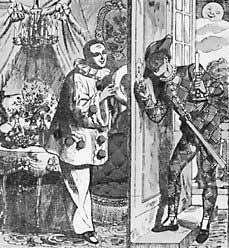 Although there is no record of a Zanno called Billy Blin, Burlow Beanie, or Billy Barlow, it's here that he would style="padding: 5px; fit most comfortably.