|
A PANORAMA OF BUSH SONGS � ABOUT THE SONGS
|

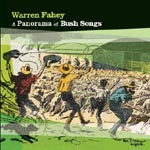
Technical assistance by Simon Rodeghiero, s-tek audio, Adelaide, South Australia Mastering by Al Sankauskas, ATD, Adelaide, South Australia Produced by Warren Fahey and David Mulhallen (who did most of the work) Notes by Warren Fahey Cover image of 'The Shearer's Hornpipe' from a 19th century postcard, State Library of New South Wales Collection Artwork by Milc Studio, Paddington, NSW
Released on Rouseabout Records
|
Ginny on the Moor.I have been singing this old song for nigh on thirty years and I still love its high drama of romance, rejection, deception, revelation and eternal love. It is a soap opera in ballad form. I first heard it from Simon McDonald on the splendid Wattle release of 'Traditional Singers and Musicians in Victoria' (1957) and was captivated by the singers' interpretation. I recommend anyone interested in the journey of British ballads in Australia to search out Hugh Anderson's book 'Time Out of Mind' (published 1974).
Golden Vanity.Another song from Simon McDonald however, over the years, I have grown into the song and note some variations or idiosyncrasies. I first recorded this for EMI on 'Limejuice & Vinegar' (the first commercial record I recorded in the sixties) and I still enjoy this high sea chase and the sad lament of the little cabin boy.
The Wonderful Crocodile.When I left school in the early 1960s I discovered The Bush Music Club and a whole world of Australian material. Prior to this, when a smart-arsed high school lad, I used to go to regular folk clubs like the Greenwich Village and Folk Attic but it soon became obvious that I would have to search harder if I wanted to find songs about Australia. The Bush Music Club filled that bill and whenever I sing this rollicking song I can picture the Fellowship of Australian Writers Hall where the Club met in an almost clandestine atmosphere as we sang from bound copies of the Singabout Songster. The song, sometimes known as the Royal Crocodile, has also been collected in Britain. The last verse about seeing its tail near the Nile refers, I assume, to the pyramids.
A Long Time Ago On The Logan.This is a song I had from Cyril Duncan and one that he had from his bullock driver father, who operated in the Nerang District. The song is interesting because it tells, in a light-hearted fashion, of a sports day held by the local Aboriginal community. According to Cyril cobbles are carpet snakes, Carbuckers wallabies, Yirrigan is a native dog, Bouribi a native bear, nullas a native weapon and churrongs are eels. These are my spellings so don't take them as gospel. Blow was the nickname of one of the crew and Old king Bill was a celebrated Aborigine. Beaudesert is on the Logan River. A few years ago I was contacted by a descendant of 'old Blow' and this song now plays in the local indigenous Museum.
The Wild Boy.John Meredith collected this song from Sally Sloan. I met Sally several times and whenever she sang this song it was with deep reverence for the prodigal son. I like the simple Celtic harp accompaniment provided by Cathie O'Sullivan. This is from a Festival of Folklife Concert at Sydney Opera House, 1980. I introduce it as 'drunk's song' but really meant a maudlin song as favoured by those who cry into their beer.
According to the Act.Captain Watson, out of Melbourne, sang this song and I learnt it in the late sixties and, once again, my source was the 'Traditional Singers and Musicians in Victoria' Wattle collection. In 1973 I taped similar words from Jim Cargill, Randwick, New South Wales however he called his 'Limejuice and Vinegar'. The chorus of 'limejuice and vinegar, according to the Act' refers to the regular ration of the mixture dished out to sailors to ward off scurvy. This compound was one of Captain Cook's lasting legacies to the Royal Navy. A live recording from the Sydney Opera House 1980.
The Maids of Australia.I recorded this wonderful song from Jimmy Cargill in Randwick, NSW, in 197� Jimmy, then in his late eighties, had heard me on ABC radio talking about sea songs and contacted me to see if I was interested in one that he had learnt from his father. The song was a version of The Gumtree Canoe that he sang in his strong Scottish Australian accent. During the course of our tape recording sessions he delivered many sea songs and, when asked if he knew any of the 'bawdy below deck songs' he made sure the landlady wasn't listening and sang me this erotic song and, in the process, solved a mystery. 'Maids of Australia' had previously been recorded in England where Harry Cox (recorded 1953) sang what sounded like 'One day as I walked by those Oxburgh banks'. I had looked high and low for the Oxburgh River to no avail. When Jimmy Cargill sang 'One day as I walked by those Hawkesbury banks' all fell into line. Incidentally, it is one of the few erotic songs in our folk song catalogue and the first song to deal with the sexual dalliance of settlers and indigenous Australians.
10,000 Miles Away.Seems I developed a quasi-Cockney sailor accent for this one. Haven't a bloody clue why, but that sort of thing can happen when you sing one of the well-known songs � anything to give it a different drum. The journey to the Colonies, be it as a transported prisoner or free will, must have been a nightmare. It was more like 16,000 miles but when it took three months who's counting? This came to me from Jack Pobar of Toowoomba who I taped in 1973 however his version was not complete so I added verses from the version printed in 'Songs of the American Sailorman'
The Pommy's Lament.Was this our first 'whinging Pommy'? There's little doubt that early settlers found the bush an unsettling adventure with almost impenetrable forests, terrifying reptiles, insects and killer kangaroos, not to mention the spear carrying native population. As the song suggests: 'If you want to become an orang-utan, go to the bush of Australia'. This was recorded as part of the Billy Barlow song-cycle.
Colonial Experience.I first learnt this song for an ABC radio program where I wanted to capture the spirit and confusion of the new colony. It doesn't paint a pretty picture and once again points to the damned climate and stinging insects. At least the song acknowledges there was gold to be found however, as Rad Dawson told me: "There's plenty of gold in Australia but the trouble is there's a bloody lot of dirt mixed in with it!"
The Nugget Family.I like this song with its references to the various major nuggets unearthed during the gold rush era. They make quite a family: Great Britain, Blanche Barkly, Native Youth and Welcome. The song comes from Coxon's Comic Songster. The song can be dated to 1858; the year Welcome joined the Nugget family. The tune is the ever-popular Bow Wow Wow. I have never heard anyone else sing this song.
The Old Man Kangaroo.This is a great song from the early days of Australia when many of the population feared kangaroos as demonic creatures. Some swore they ate human flesh whilst others swore they grew to over eight feet tall and would box any man to the ground. I've been happily singing the Simon McDonald version for about fifteen years but when David was going through my tapes he found a much earlier version where I had used the version published in Stewart and Keesing's edition of Old Bush Songs (1957) which appears to be an amalgam of a version collected by Dr Percy Jones and the John Meredith collected verses from 'Hoop iron' Jack Lee.
Garrawilla.I learnt this over thirty years ago from the Bush Music Club repertoire. It is one of the few surviving songs that actually raise a toast to the life of the shearer and another one for the station boss. Garrawilla is an actual station near Moree in New South Wales. It comes from the singing of Jack Wright, collected by John Meredith, who had it from his father who had been a shearer on the station when a shed hand had composed the ditty. I like to bounce the song along.
The Limejuice Tub.I was in Maryborough, Queensland, collecting in the seventies when I made contact with Mr Gilmer who told me "he had an old bush song I might be interested in hearing.". Mr Gilmer, had heard the song when he was shearing in the Riverina district some fifty years earlier. It was the only song he knew and I nearly fell on the floor when I heard him sing a complete text for one of the most elusive shearing songs. John Meredith had collected two completely different verses as 'Rub-a-dub-dub' and then there's A L Lloyd's popularised composite verses. Mr Gilmer thanked me for recording the song saying, "I thought it might be important to save."
The Hardest Bloody Job I Ever Had.This is sometimes known as ''Ard Tack' and the only shearing song that is set in a winery. Fact is that many of our early farmers planted grape vines in the hope of a small additional income and, as we know, many of these have become major wineries. Recorded from Jack Davies, a pioneer soldier-settler of the Leeton district. I can't help but smile every time I think of the woozy shearer falling asleep with his arms around the dazed sheep.
Goorianawa.I heard Duke Tritton sing this on a couple of occasions and always with great reverence. He said he first heard it when a youngster of about twelve years of age. The shed, one of the biggest, was situated between Coonabarabran and Coonamble and operated by the fearsome Cuthbert Featherstonhaugh who, according to Duke, insisted that the shearers 'pink 'em' with their knuckles down. I recommend the story of Duke's remarkable life, 'Time Means Tucker', for an insight into the life of a shearer at the time of crossover from blade to electric.
One of the Has-beens. I'm not sure but I suspect I learnt this one from the singing of Gary Shearston who also recorded it on his landmark 'The Springtime It Brings On The Shearing' for CBS Records in the sixties. The song has a serious side for aches and rheumatic pains were the bane of all shearers and, as they were paid on results, old age meant less sheep shorn and less money. I have heard old hands tell of crawling to the huts on all fours after a day on the board. The words were written by Robert Stewart and, some how or other, found themselves in the bush and married to the popular tune of 'Pretty Polly Perkins'.
Jog Along Till Shearing.My old mate, the late and greatly missed Russell Ward, collected this as taped by Jeffery Way and Edgar Waters from the singing of Joe Cashmere. It was published in Speewa, the journal of the short-lived Australian Folk lore Society. I use a variant of Bow Wow Wow that, I suggest, suits the tale of the wayward shearers admirably. I can picture the half-boozed shearers 'sleeping on verandahs and lounging on the sofas' before they're 'ordered off as loafers' and ready to return to 'home, sweet, home' � wherever that might have been.
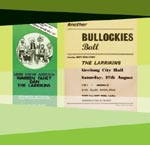
Euabalong Ball. I love the idea of the shearers, playing hard, waltzing around the shed with a greasy sheep as a dancing partner. A great bush song, that appears to have substantially benefited from a certain amount of creative input by A. L. Lloyd. The Larrikins used to love lifting this one up with a waltz tune in the middle of the rendition. I share the verses with Jacko Kevans who was a mainstay of The Larrikins for many tours.
The Carrier's Song.Life on the road, or what went for roads, must have been a trial and who better to sing about the mud and rain than a carrier. I learnt this for an ABC program but decided to keep singing it because no one else seemed interested. It is usually attributed to George Chanson as it appeared in his Sydney Songster however he did not make any claim on authorship so the answer is a question mark. Yes, good old Bow Wow Wow appears again as the tune vehicle, showing that a good tune can sound different every time.
The Station Cook.Percy Jones first recorded this familiar cry from the stomachs of men who needed to be fuelled five times a day and supplied with gallons of strong tea. As the old saying offered: who called the cook a bastard? To which the inevitable response would be: who called the bastard a cook! In truth the old station cook worked when he wasn't sleeping and slept when he wasn't working: it was a hard job.
The Freehold On The Plain.This song was included in A B Paterson's 1905 edition of Old Bush Songs and captures both the excitement and frustration of the Free Selection Act. Although set to 'The Little Old Log Cabin Down The Lane' my rendition seems to take off with a huge nod and a wink to the Carter Family and why not! This 'very live' recording was made at the 'While The Billy Boils' concert, Three Weeds Hotel, Balmain, in 1991.
The Flash Stockman.This anonymous rollicking song belongs to a large group of 'boasting' songs that finds the singer skiting about their amazing skills. In this case our stockman is 'Duke of every blasted thing' from horse riding to shearing and so talented he advises he should be "cut in two � for he's much too bloody good to be in one." I refer readers to Duke Tritton's 'Shearing In A Bar' since this seems to apply to all such skites whose skills multiply after a few good drinks. This is the version recalled by A.L.Lloyd who heard it in the 1930s. The 1933 Ben Bowyang Reciter has another version.
Tumba-bloody-rumba.After reading John Wolfe's poem I decided a tune was definitely necessary so I borrowed 'Jack of All Trades' and married the two. I've been singing it ever since and still enjoy the somewhat improbable story lines and shooting bloody kangaroo at Tumba-bloody-rumba. Tumbarumba is on the New South Wales Victorian border.
Morning of the Fray.Frank Gardiner was without a doubt our most outrageous and successful bushranger and he supposedly wrote these words after the hold-up at Eugowra Rocks. I've never heard anyone else sing it except Bert Lloyd and I've always wondered why. The best part of the story is that Gardiner, although captured, got away with the gold. It's a real Great Train Robbery story from a century before. There's a story suggesting that years later, after Gardiner had relocated to California and eventually got shot in a bar, that two men, presumably his sons, arrived in Eugowra and left a week later, presumably with the bushranger's bounty.
Frank Gardiner Is Caught At Last.I've long been fascinated with the Gardiner myths and learnt this ballad some thirty years ago. Nancy Keesing discovered Mrs Popplewood through the information of a Red Cross welfare worker that was looking after the old lady in the mid 1950s. Nancy Keesing brought John Meredith in to record some of Mrs Popplewell's songs including this bushranger ballad, which, to my knowledge, has not been recorded from any other singer.
Over the years I have been fascinated by the last verse which warns 'when lives you take a warning, boys, a woman never trust' and eventually curses the day 'he first met Mrs Brown.' I had assumed Catherine Brown, Gardiner's de facto, had turned him in. I now think this is unlikely since she appears to have led the campaign to get him freed. Recently I have come to think that possibly Mrs Brown was Catherine's mother. For a fascinating history of Gardiner read Alec Morrisson's 'Frank Gardiner � from bushranger to businessman' (published Wiley Press 2003)
The Streets of Forbes.Supposedly written by John McGuire, Ben Hall's brother-in-law and an eye-witness to the police procession that dragged Hall's body through the streets of Forbes. I find this song difficult to sing without picturing the ambush and slaughter. On another piece of bushranger folklore Ben Hall's son was part of an early circus that travelled Australia showing the young boy as 'the leopard boy' � he had exactly the same number of spots to the gun shot wounds on his father's body. Believe it or not!
My Name Is Edward Kelly.I recorded over thirty songs from Cyril Duncan of Hawthorne, Queensland, and although I kept in contact with him, I suspect there was many more buried in his repertoire. Most of his songs came to him from his father and, in so many ways; Cyril represented the changing of the guard in old bush songs. By 1974 (Cyril was born 1907) television had well and truly changed our entertainment patterns and singing old songs just didn't seem to fit in. Cyril Duncan was the sole carrier of this great Kelly ballad, which, being sung in the first person is full of drama and pathos.
|