|
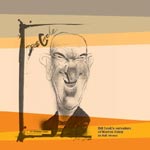
Bill Leak's caricature of Warren Fahey in full steam
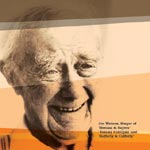
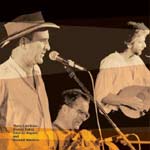
Joe Watson. Singer of �Heenan & Sayers� �Tommy Corrigan� and �Rafferty & Cafferty�
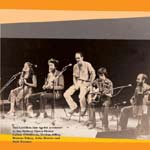
The Larrikin line up for a concert at the Sydney Opera House Cathie O�Sullivan, Declan Affley, Warren Fahey, John Morris and Jack Kevans
Three Larrikins... Warren Fahey, Dave de Hugard and Michael Atherton
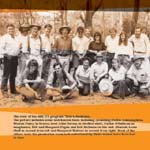
The crew of the ABC TV program �That�s Australia�. The picture includes some well-known faces including (standing) Robin Connaughton, Warren Fahey in braces, host John Derum in checked shirt, Cathie O'Sullivan in sunglasses, Bob and Margaret Fagen and Bob McInnes on the end. (Seated) Liora Claff in second from left and Margaret Walters in second from right. Most of the others were the production team and, unfortunately, there names have been lost in time.
CD label
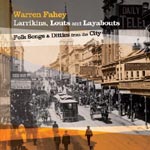
Track selection and editing by David Mulhallen Technical assistance by Simon Rodeghiero, s-tek audio, Adelaide, South Australia Mastering by Al Sankauskas, ATD, Adelaide,South Australia Produced by Warren Fahey and David Mulhallen (who did most of the work) Notes by Warren Fahey Cover photograph of King Street, Sydney, State Library of New South Wales Collection Artwork by Milc Studio, Paddington, NSW Released on Rouseabout Records
|
The Pub With No Dike.I came across this in an old Singabout Songster and it tickled my fancy so I started to sing it widely and freely. Folks love a parody and this one certainly tickled their fancy. It reminds me of that other country hotel special � the 'deadhouse' � which was an anonymous shed out the back of the pub where drunks were deposited until they sobered up after 'sleeping like the dead'.
Blast of the Trumpet.Here's a ditty that praises our pioneer sportsmen and compares 'Australia to a dahlia'. Our nation had no roving knights, no major military heroes and no great myths so we had to create them out of sportsmen and super workers like Crooked Mick. We still appear to talk about our sporting heroes as icons. This little gem comes from the Asian Broadcasting Union special I scripted in 1979.
Heenan and Sayers.This is a composite that I put together out of some verses recalled by Joe Watson and a few lines from Cyril Duncan. Both knew the story of this extraordinary boxing match, the last before the introduction of Queensbury Rules in the mid eighteen hundreds. There were several ballads written about this bloody match of champions and they all salute the endurance of the two fighters who fought 'till the claret it did flow'. Joe Watson also knew some of the lines from another great boxing ballad, 'Morrissey and The Russian'.
Les Darcy.Australia's fighting boy and Maitland's pride and joy' � Les Darcy was collected from Cyril Duncan and I also got a version from Jack pobar in Toowoomba. The original was most probably written and published (as a broadsheet) by 'Percy The Poet' (P.F.Collins). When Les Darcy died of pneumonia in America in 1917 he was at the height of his short career. Soon after his death a rumour spread that he had been poisoned and another that he had died of a broken heart
The Two-Up Song.My father, George Fahey, was a shower singer and knew all manner of Irish songs and ditties. This one, to the tune of 'I'm Forever Blowing Bubbles' is about Australia's favourite gambling game and 'the fairest game in the world'.
Tommy Corrigan.I recorded this song from Joe Watson who loved a horse race and was old enough to remember the legend that was Tommy Corrigan. Some say the Melbourne jockey was the greatest and this song was circulated as a broadside a week after his death in 1894, when he was trampled to death by a horse, as he rode in the Caulfield Cup. The Wearing of the Green carries the song. Dave de Hugard Bob McInnes Chris Kempster Andy SaundersI'm A Tolerant Man.This song appeared as a poem in the Kalgoorlie Sun newspaper and I still smile at the irony expressed. I'm old enough to remember the Tamborine and drum thumping of the Salvation Army and other kerbside spruikers. As a young boy I regularly went to the Sydney Domain on a Sunday to hear the speakers be they political fanatics, bible-bashers or just some mug who mounted a soapbox.
Rafferty and Cafferty.Joe Watson of Caringbah sang me this song when he was ninety-two years old. It's actually two items I pieced together as I have joined Joe Watson's 'Stump Speech' in with Rafferty and Cafferty � a simple case of Rafferty's Rules! The stump speech is a folk creation to take the mickey out of politicians � the art of saying a lot without saying anything at all. I would date this around the nineteen hundred mark and it quite possibly came from the Music Hall.
The Gumtree With Six Branches.A singer never quite knows where a song will pop up and this one came to me from the Imperial Songster around the time of Federation. I fashioned the words to the tune of 'Australia's on the Wallaby' � a fitting tribute to Federation. The chorus is a mouthful comparing the gumtree to our flowering nation and the six branches were the then six States of the old Colony.
Unity Boys.I have always been interested in the left side of the political spectrum and especially Labour history. It's hard to imagine that Australia had the worlds first fully elected Labor government. The song comes from the Great Shearer's Strike of the last decade of the eighteen hundreds. This was a bitter struggle that just about ruined the Amalgamated Shearer's Union but win they did and in doing so laid the foundation for the Australian Labor Party. The poem was a natural for the tune Tramp, Tramp, Tramp as used in the Wallaby Brigade. The song also acknowledges the Falkiner family who operated some of the larger South West New South Wales stations including Boonoke, near Deniliquin, which, during the nineteen seventies and eighties, was owned by Rupert Murdoch. I should also add that this is included as a historical item and I can't really imagine anyone else singing these tongue-twisting verses. Dave de Hugard Chris Kempster Bob McInnes Andy SaundersAmalgamated Shearer's Union.Another bit of Labour history and I got this one from the Shearer's and General Labourer's Record. I rounded up some of my fellow 'larrikins' to get this one down on tape for an ABC radio program. These rhyming acrostics were popular with early newspapers and magazines.
Baa Baa Merino Sheep.Proving political parody knows no master here is a piece from 1918 that uses one of the most popular nursery rhymes. In this case both the shearers and the station owner present their case however since it appeared in a Farmer's Magazine the station owners have the ruling hand. I found this as an old newspaper clipping during one of my regular digs in the Mitchell Library.
The Miner.I collected this in 1973 from Mrs Frances McDonald in Broken Hill. Mrs McDonald actually started to sing 'Don't Go Down The Mine, Dad' and went into these verses in the middle of the song. Believe it or not this medley was popular in the Hill as a waltz tunes for local dancers.
Blue Whiskers.There was a dreadful strike in 1919 in Broken Hill that separated families because the mine operators encouraged scab labour. Blue Whiskers, so named because he probably had a red beard, was a striker 'with legs upon his chest'. It is set to the old IWW wobbly favourite, Casey Jones, and is a localised version of a Joe Hill original
Packer the Scab.Another ditty from the same struggle in Broken Hill and this one is set to the tune' Only a Button Between You and Disgrace'. Fred Bartley of Broken Hill sang this one for my collection in 1973. One of the other scabs was a man named Bill Bailey and the unionists taunted him by simply singing the words of the popular song 'Won't you come home, Bill Bailey, won't you come home?'
Lithgow Onwards Struggle.This was formally titled 'Jingle on the Lithgow Ironworks Tunnel Struggle' and was printed as a one-penny broadsheet by the Lithgow-Hartley District 8-Hour Day Committee in August 1911. It was quite common to sell such sheets as a way of raising both awareness and funds during strikes. This one supported the Ironworks Relief Fund and was collected from Jack Mays, in Lithgow in 1973. I set the tune to the poem for an ABC documentary. Once again, it is included as an important historical document.
When You Give That Tuppence back, Charlie Dear.This is a union song with a noble history. It concerns the bitter 1911 strike where Charles Hoskins, the mine operator, responded to the union request for an additional tuppence a ton by reducing their rate by tuppence. This was an old style battle that went on for months and ended when the strikers attacked the scab labourers who were keeping the mine operational. Hoskings new T-Model Ford was burnt to the ground and the police thrown in the nearby water slush pond. The tune was designated as 'When the Sheep Are In The Fold, Jenny Dear'. I also got this one from Jack Mays and I recorded a version for the first larrikin album I ever released, Man of the Earth.
Norman Brown.I had forgotten I had recorded this stirring ballad from the Hunter Valley struggles. It was written by the late Dorothy Hewitt, in 1959, and also included on Man of the Earth. The struggle dates back to 1929 and was one of the fiercest confrontations between government and labour. Norman Brown, a twenty-eight year-old miner, died from wounds to the stomach after the police fired on the strikers by order of the government. Several other miners received serious injuries.
Four Little Johnny Cakes.I wrote a book on the history of eating and drinking in Australia titled 'When Mabel laid The Table' (State Library of New South Wales Press) and attempted to explain where our food folklore and social history sat. Much of it saluted our pioneering past and simple delights such as the Johnnycake. I'm not sure where this idiosyncratic interpretation came from; David unearthed it whilst hunting down songs from my dark past.
On The Steps Of The Dole-Office Door.My friend and fellow folklorist, Assoc Professor Graham Seal, once produced an album of 1930's Depression songs and poetry for Larrikin and I've been singing this ever since. Poor old Jack Lang copped it from all sides but that's what happens when you front the workers in battle. The tune is The Stone Outside Dan Murphy's Door.
We're On The Susso Now.(And we can't afford a cow). My father sang this ditty however I know it was extremely popular as a chant, especially when people were doing the Scullin government introduced sustenance work around the city.
Although we've plenty of bees and cows Soup.One suspects this piece started life as a Wobbly song during the American Great Depression and was quickly seized by the locals after the introduction of our soup kitchens. There was obvious bitterness that our men were sent away to fight in WW1 and then found them selves on a soup-line. My parents managed through the Depression with occasional work and a tightening of the belt that no one should endure. I always remember my Mother urging me to eat my meals by saying they ate bread and dripping through the bad years. I'd laughed then but never now.
The Two Professional Hums.I recorded this gem from Harry Chaplin of Broken Hill, in 1975. The tune, 'Jolly Lads Are We', appears to be a re-working of a Harry 'Haywire Mack' McClintock song along a similar theme.
The Swagman's CurseThere ain't no work in BourkeDamn all at Blackall No lucre at Echuca Things are crook in Tallarook Might get a feed at the Tweed No feedin' at Eden Might get a berth in Perth In goal at Innisfail Got the arse at Bulli Pass Cockies of Bungaree.I'm not sure if I learnt this version from Simon McDonald or from Dave de Hugard or Bert Lloyd, the latter being two of my favourite revival singers. It's possibly a combination of all three. Bungaree is located in Victoria and is well known as a potato growing community. Spud chipping was one of the worst jobs a man could do. Most decided against it or avoided it like the plague. It reminds me of the old yarn where the farm hand is offered a job chipping potatoes. He thinks about it for a minute, looks at the farmer and says: �Nar, don't think so. I reckon you should bring back the cove who planted the spuds � he'll know where he put 'em�.
The Homeless Man.I first met Harry Robertson in the nineteen seventies and we became firm friends through thick and thin. He and Rita were generous hosts and I loved nothing more than a night at their Balmain house eating traditional salted cod stew which Harry made in a giant boiler, smoking his stinking Rotterdam Shag cigarettes all the night. We'd sing and talk and argue and sing some more. He encouraged me to learn some of his songs and this was the first. This rendition was recorded at a Festival of Folklife concert at Sydney's Regent Theatre, in 1979, where we devoted a segment to the wonderful songs of Harry Robertson.
The Pig Catcher's Love Song.Ron Edwards collected this from Jack Crossland and published it in his Overlander Songbook, 1969. It's a tribute to Cairn's Bitter Beer. I spent many years trawling through Ron's many books and actively added his collected songs to my repertoire. I have never been able to work out why other singers ignore such treasure troves.
Eighteen Pence. Ron Edwards collected this ditty off Tony Davis, in 1970, who said he had heard it in Townsville some years earlier. Ron also collected it again that same year from Harold Hill who had been born in 1893. My guess is that the song started life as a Music Hall item. It's fun to sing. I particularly love the last verse and the frontier-town reference to 'plenty of other men, but they're mostly in goal'.
The Girl on Bondi Beach.A quaint piece of Sydney beach history, which dates back to the prudish 1950s. It's odd to think that young women were ordered off the beach for wearing a bikini when nowadays they wear no tops at all. The Sydney Sun, like the bikini top, has also disappeared with time. The tune is Show Me The Way to Go Home. I have no idea how this song ended up in my repertoire.
Up and Down the Sydney Road.A ditty from the Great Depression, which pokes fun at the reality of hard, times life. Mrs May Colley sang this for me when I recorded her songs at the Bathurst Old People's Home. Mrs Colley also played the concertina and had earlier been taped by Alan Scott.
Across the Western Suburbs.This song is a good example of how contemporary songs represent the continuing tradition of folk song. Denis Kevans ands Seamus Gill wrote the song and it was published in Australian tradition in 1973. I started singing it around the same time as The Larrikins toured across Australia. I like to think it made people think about how the old-style Australian city was disappearing and being replaced with concrete and glass. I preferred the old look.
Take Your Bulldozers Away.I first heard John Dengate in the late 1960s when he was an active member of The Bush Music Club and I was soaking up anything that had a strong Australian voice. I've been a fan of John's songs ever since and have learnt several of his witty creations and I was bold enough to release an album of his political songs when I worked for Rupert Murdoch! This song dates back to the seventies when, despite the Green Bans of the building unions, Sydney's guts were being ripped out by greedy developers. I recommend John Dengate's book 'My Shout' (1982) to anyone who enjoys good topical songs. Cutler, referred to in the first verse, was Minister for Planning in the early Neville Wran Labor Government.
The Balls of Bob Menzies.My father really hated Bob Menzies, or more specifically, what Ming represented. I dedicated my book, 'The Balls Of Bob Menzies' (1989) to Dad's memory and his determined rationalism. I am old enough to reflect on Menzies' pomposity and how John Howard has carried that mean-minded flame into the new century. I don't think either politician had any balls.
The F1.11I can't imagine how many times I sang this song in the seventies and eighties when The Larrikins toured. It was always a favourite and, unfortunately, the darned things are still the dominant part of our air force. Lyell Sayer wrote the song and fashioned it to a traditional tune. Clem Parkinson, that other Melbourne rebel song-maker, also provided a final verse for the times.
Doctors' Fees are Ruining My Health.This one is from Clem Parkinson and another song that I sang with political relish. I liked the idea of the doctor taking an x-ray of a wallet � too true. I included this song in my book, 'Ratbags and Rabblerousers' (2000)
On Top Of No Smoking.This is a song, set to the tune of 'On Top Of Old Smoky', was published in 'Freedom Songs', the songbook of the eureka Youth League, Melbourne. Artie (Arthur) Fadden was Federal Treasurer in the Menzies Liberal Government.
Life Wasn't Meant to Be Easy.I bet Malcolm Fraser regretted ever spruiking the words; �Life wasn't meant to be easy.� because they sure came back to bite him on the bum. The words are by Lyell Sayer, Melbourne. Whenever I sang this in the seventies I felt I was contributing to the well being of the nation. I have been fortunate to have Gough Whitlam as a friend for some years. We lunch every few months and share jokes and ditties like this one from the seventies.
Bobby, I Hardly Knew You.Folk parody knows no master and is just as likely to kick the left, as it is the Right. All politicians are fair game because, as my father always said: whoever you vote for a politician gets in. John McQuiggen wrote these clever words and set them to the familiar tune of the old Irish anti-war song 'Johnny I hardly Knew You' ... 'Bob Hawke went in red and he came out blue, and the Liberals didn't know what to do.� Mind you, I will always remember the good Hawke initiatives and especially the time he invited myself the Larrikins to play at the first State Dinner in the new Parliament House. We all stayed up until the wee hours singing rebel songs in the Speaker's Office (Leo McLean had the largest bar fridge!). I can't imagine John Howard singing anything other than a hymn or possibly 'Up There Cazaly'
Thanks To The Yanks.I am really disappointed how Australia has seemingly become a faux State of the USA. I have been accused of being a 'cultural protectionist' and I proudly accept that label. I don't hate America but I do object to our government, especially the Howard tenancy, opening the gates of free trade and swamping our culture in the process. John Dengate feels the same and this song is intended to make us all think hard about closing those gates.
|
|