ACROSS THE SEVEN SEAS - The Australian Maritime Collection© Warren Fahey Being an island continent has always shaped Australia’s history. Our early indigenous people came down by sea from the north and lived here for thousands of years before that extraordinarily skilled navigator, Captain James Cook, mapped the coastlines - and hoisted up the Red, White and Blue for the British Empire. Ever since Cook’s declaration the sea has been a vital part of our nation and identity, and all the more strange considering that for all of the nineteenth century the majority of Australians lived away from the coast, in the bush. The majority of songs from the transportation era are understandably plaintive and tell of the dreaded separation from family and lovers; fear of being sent so far away from their homeland; deprivation and mistreatment by their carers and the system and, finally, heartfelt warnings to others ‘lest they too be transported’. Whilst conditions in England’s goals were horrific the thought of hard months spent on the ocean voyage to Australia was often feared more. Many died on the passage, some of fever, some of malnutrition and others of sheer terror. There was also the real fear of shipwreck and several convict ships, including those carrying women and children, found themselves in a watery grave. There were many crimes punishable by transportation to Botany Bay and, later, the other penal settlements of Norfolk Island, Van Diemen’s Land and Moreton Bay, including poaching, murder, forgery, theft and political agitation. One song in the collection, simply titled ‘Australia, Australia’, is a shortened version of a longer ballad ‘Virginny’ created during the American Revolutionary War (also known as the American War of Independence 1775–1783) when Britain used Virginia as the main destination for the transportation of their convict class, is unusual in as much as it concerns highway robbery and, as an added emotional trigger, a crime motivated by love. There are extremely few transportation songs about highwaymen because most of the offenders were executed. Another song, ‘Botany Bay Scoundrels’, presents a litany of scoundrels, whores, crooks and pimps, and why they were shipped out to Botany Bay. Every lowlife gets a serve in this somewhat ribald song that dates back to a printed broadside (circa 1790) where it was simply called, ‘Botany Bay, A New Song’. This rare find comes to us from the Mitchell Library, State Library of New South Wales, and was originally located by that extraordinary hunter of documents and books, David Scott Mitchell, for whom the Australian library is named. Unlike many broadsides of the time this song, with its obvious sarcasm ‘to make a new people in Botany Bay’, would probably have been favoured by the snobbish upper classes until they discovered the barbed final verse reminding them of Governor Lachlan Macquarie’s comment that Australia was settled by people sentenced here, and those that should have been! Ships also brought optimistic free settlers and later, even more optimistic gold seekers, then came the waves of immigrants as the giant sail and steam ships landed their human cargo of ‘new chums’ and sailed off with our famed wool, beef, timber and wheat. Other songs and shanties came to us from whalers and seal hunters who worked our coasts and fishing fleets trawling the sea’s then rich harvest. Sailors are the world’s great travelers and it is for this reason their tradition is full of story songs that have also traveled. Australia grew up in the golden age of sailing ships when sleek, powerful clipper ships ploughed the oceans on the Britain to Australia run. Some of the world’s most famous ships like the Cutty Sark and Marco Polo serviced the Australian ports and brought songs with them. Ben Bright, born in Llanllechid, North Wales, in 1896, was 76 when his unique repertoire was recorded. He would have been one of the last sailors to bridge the old days of sail and the new. He was an active ‘wobbly’ joining the International Workers of the World in America in 1916 and continuing his ‘direct action’ in Australia in the 1930s. He spent most of his life at sea and eventually returned to Australia in 1972 to retire and claim a pension. His repertoire included shanties, bush songs and some unusual maritime songs like ‘The Handy Barque The Campanero’ which is essentially a rant against a particularly despised sea captain.
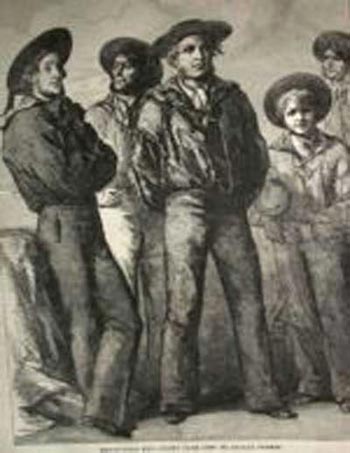
The song appears in Stan Hugill’s Shanties of the Seven Seas as a pumping song however Bright’s version is a forebitter. ‘The Academy of Mister Paddy West’, another of Ben’s songs, concerns a mythical figure in maritime folklore known for operating a dodgy ‘school’ for would-be sailors. Legend has it that Paddy West’s crimping methods involved putting completely inexperienced seamen through a half-hour crash-course. This song doesn’t seem to have been collected from any other singer and it is also interesting because of its reference to steam. Some of the song also appears to have been borrowed from a sea song called ‘Away, Susannah’. Ben Bright introduced the song by saying, “There was a fair amount of singing went on in the sailing ships. Once you got settled down in a ship you got to know each other pretty good. Fellas’d tell stories of their experiences about shanghai-ing or boarding house masters like Tommy Moore, y’know. Or maybe somebody would have an accordion or a mouth organ and you’d hear songs in every language under the sun, and in broken English. I remember a fella called Peterson, a Swede, used to sing this song about Paddy West’s Academy’. The nineteenth century sailor was often portrayed in a romanticized fashion - a ‘roving blade’ with a ‘girl in every port’- but, in reality, it was a difficult life. Conditions on board ship were uncomfortably cramped, food was often scarce or inedible, hours were long and, if the captain and mate were ‘hard men’, it could be unbearable. There was also an ever-present danger of drowning, and many early sailors met a watery grave. Countless songs relate tales of the sexual misadventures of sailors whilst in port.
Shanties, maritime work songs, are an obvious link with the past and many were used on the Australian run. In 2007 I discovered a rare collection of such shanties, taken down, including the musical notation, from a whaler and sealer on Kangaroo Island, South Australia, in 1923. You can see this collection, including the words, at http://warrenfahey.com/ccarey.htm There are also songs about maritime disasters, especially shipwrecks. The collection offeres for the first time three ballads that tell of such tragedy, two of them taken down from first-hand accounts from survivors. The Melancholy Loss of the Amphitrite' is a good example of the maritime distater ballad. The convict ship Amphitrite sailed from Woolich Pier for NSW in August 1834, with 108 female convicts, 12 children, and a crew of 16. The ship, only three quarters of a mile from the English shore, was caught in a gale off the coast of France and ran aground. The French attempted to help her and offered to take the convicts and crew ashore – but the Captain and Surgeon, fearing they had no right to liberate convicts, refused all offers of help. The ship was torn to pieces with only two members of the crew as survivors. It is indeed a sad tale and one can almost hear the agony in the desperate verses. The broadside was published by W & T Fordyce, Printers, Dean Street, Newcastle, and was not dated however one imagines it went into print soon after the tragedy in 1833. The Sydney Gazette reported this first-hand account: “It makes the blood run cold to read of such horrors. If ever there was a multiplied murder it was in the case of those hapless beings, whose lives might have been saved, but for the obduracy of their temporary gaolers who sent these people to destruction – on the cold-blooded plea that they had no orders to save them. The name of the Amphitrite and her immolated human cargo must ever raise a blush on the cheek of true-hearted Englishmen.” Another song, closer to home, was ‘The Wreck of the Dunbar.’ Adapted from first hand accounts and the published narrative verse of Mr Samuel Bennett, Sydney, 1857.The merchant ship ‘Dunbar’ was shipwrecked around midnight August 20th, 1857, almost under the lighthouse, at South Head, Port Jackson – now known as Watson’s Bay. The Dunbar weighed in at 1980 tons had 121 people on board, 59 crew and 62 passengers, mostly long-term residents and ‘respected old Colonists who were on the way back from a visit to the father-land’. The Captain was also well known in the Colony and much esteemed. There was only one survivor of this terrible shipwreck. A little-known song concerns ‘The Royal Charter’. On the 25th October 1859 The Royal Charter, a combined steam and sailing ship from Melbourne bound for Liverpool, was lost off Moelfre, on the island of Anglesey, Wales. She was built at the River Dee Dockyards and launched in 1857. The Royal Charter was a new type of ship, a 2719-ton steel-hulled steam clipper, built in the same way as a clipper ship but with auxiliary steam engines, which could be used in the absence of wind. The ship was used on the route from Liverpool to Australia, mainly as a passenger ship although there was room for some cargo. There was room for up to 600 passengers, with luxury accommodation in the first class. She was considered a very fast ship, able to make the passage to Australia in less than 60 days. Almost at the end of its long voyage from Melbourne to England the Royal Charter was carrying four hundred and fifty-two passengers and crew, and gold from the Australian goldfield valued at £320,000. It sailed into the worst storm that had occurred in the Irish Sea during the nineteenth century. Seeking a safe harbour to wait out the terrible storm the ship's anchor chain broke under the strain and drove the Royal Charter stern first onto the rocks off Moelfre. The ship struck the rocks fifty-yards from the shore and broke into two sections. Every person on board was thrown into the sea except for thirty-two whom perished as they were hurled against the rocks. Many of the passengers were men returning from the Australian goldfields and some had attempted to leave the ship and swim to shore with their pockets filled with gold nuggets. The ship became known as the Golden Wreck because of this legacy. One of the most interesting songs in the maritime collection is ‘The Female Rambling Sailor’. The pioneer collectors Norm O’Connor and Bob Michell recorded this very fine ballad from Catherine Peatey, Melbourne, 1959. Mrs Peatey had spent her early life in the Warrnambool and Leongatha districts in southern Victoria. Most of her songs she learnt from her father, writing down the songs in a manuscript book, which she kept for that purpose. The incident of a young girl going to sea disguised as a sailor, sometimes to seek her true love or simply for adventure was not uncommon in traditional ballads. Although the lass in this particular song is noted as ‘Rebecca Young’, the most famous of these sailor girls was named Jane Thornton, who, reputedly, after serving in the Royal Navy, secured a Naval Pension, courtesy of the endorsement of Queen Victoria. I learnt the song in the late 1960s from the recording of Mrs Peatey in the National Library of Australia. Lest you think all the songs come from our international seafaring let me assure you that there are also some songs from our inland rivers. ‘The Old Macquarie’ features one of our most famous inland rivers. The Macquarie River is one of the main inland rivers in New South Wales and is a tributary of the Darling River. It headwaters rise in the central highlands of New South Wales near the town of Oberon. The river travels generally northwest past the towns of Bathurst, Wellington, Dubbo and Warren to the Macquarie Marshes and the Barwon River. In 1974 I recorded a 92 year old woman, Susan Colley, singing a charming version of the American spiritual, River of Jordan. The song, a children’s song, has various bush animals boarding Noah’s Ark. There’s also the tall tale of ‘The Wonderful Crocodile’ found off La Perouse – which is essentially an Australian story of Jonah and the Whale. Sydney Harbour also gets a gong in ‘Take Me Down The Harbour’. Boating and ferry trips to Sydney’s ‘pleasure beaches’ provided material for numerous songs however this one also introduced that new fashionable invention: the telephone. I sourced this charming ditty from the Imperial Songster No. 83, published by The Tivoli, in Sydney, 1909. It is attributed to Gray & Bennett. I hope the tune is close to the original. The places mentioned in the song are all inner-city harbour and surf beaches and Clifton Gardens was the earliest ‘pleasure picnic grounds’ accessible by ferry. It was a wild place and, for a time, closed because of rowdy behaviour by ‘larrikins’.
As a folklore collector I am always interested to hear from readers who recall songs about our maritime history. We place high regard on material collection but, sadly, have neglected areas like folklore and oral history. Even half-remembered lines can help solve the jigsaw puzzle of song hunting.
|
MARITIME
NOTE: This article first appeared in 'Signals' 2010 - the magazine of the Australian national Maritime Museum.
NOTE: As a folklore collector I am always interested to hear from readers who recall songs about our maritime history. We place high regard on material collection but, sadly, have neglected areas like folklore and oral history. Even half-remembered lines can help solve the jigsaw puzzle of song hunting. Warren Fahey can be contacted at: [email protected] or His new recordings are available in the ANMM Shop.
|
 & Bush Verse’ where I perform many of the songs from my collecting work. Whilst our maritime story features heavily across the series there are two albums of particular interest to readers of this magazine: ‘Rare Convict Ballads & Broadsides’ and ‘Across The Seven Seas: The Australian Maritime Collection’, as they offer many songs and shanties never before recorded.