page 9 [cont.] ...
  In the latter half of the 19th century rail became an invaluable partner in the growth and development of our rural industries. It enabled wheat, rice, wool, meat and coal to be transported to the city and export markets. Most importantly, for industries like sheep, cane, agriculture and cattle, that relied on itinerant labourers, it transported the workers. These were the days of first and second-class passengers. The itinerant workers, of course, travelled second-class, promoting poets like Henry Lawson to write poems like his haunting
'Second Class Wait Here'. In the latter half of the 19th century rail became an invaluable partner in the growth and development of our rural industries. It enabled wheat, rice, wool, meat and coal to be transported to the city and export markets. Most importantly, for industries like sheep, cane, agriculture and cattle, that relied on itinerant labourers, it transported the workers. These were the days of first and second-class passengers. The itinerant workers, of course, travelled second-class, promoting poets like Henry Lawson to write poems like his haunting
'Second Class Wait Here'.
SECOND CLASS WAIT HERE
At suburban railway stations---you may see them as you pass---
there are signboards on the platform saying "Wait here second class,"
And to me the whirr and thunder and the cluck of running-gear
Seem to be forever saying "Second class wait here---
Wait here second class
Second class wait here."
Seem to be forever saying, "Second class wait here."
Yes, the second class were waiting in the days of serf and prince,
And the second class are waiting---they've been waiting ever since,
There are gardens in the background, and the line is bare and drear,
Yet they wait beneath a signboard, sneering "Second class wait here."
I have waited oft in winter, in the mornings dark and damp,
When the asphalt platform glistened underneath the lonely lamp,
Glistened on the brick-faced cutting "Sellum's Soap" and "Blower's Beer,"
Glistened on enamelled signboards with their "Second class wait here."
And the others seemed like burglars, slouched and muffled to the throats,
Standing round apart and silent in their shoddy overcoats;
And the wind among the poplars, and the wires that thread the air,
Seemed to be forever snarling, snarling "Second class wait there."
Out beyond a further suburb, 'neath a chimney-stack alone
Lay the works of Grinder Brothers, with a platform of their own;
And I waited there and suffered, waited there for many a day,
Slaved beneath a phantom signboard, telling all my hopes to stay.
Ah! a man must feel revengeful for a boyhood such as mine.
God! I hate the very houses near the workshop by the line;
And the smell of railway stations, and the roar of running gear,
And the scornful-seeming signboards, saying "Second class wait here."
There's a train, with Death for driver, that is ever going past;
There will be no class compartments when it's "all aboard" at last
For the long white jasper platform with an Eden in the rear
And there won't be any signboards, saying "Second class wait here"
 Henry Lawson – our greatest Australian poetical voice
|
During the lean times, especially in the 1890s and 1930s, rail travel became the only other affordable option to 'shank's pony' (the Australian colloquial expression for walking), however, some could not even afford the price of a ticket. Like American we had tramps (or bums) who 'waltzing their matildas' from town to town. They called it 'jumping the rattler' and since an out-of-work individual had to prove he or she had travelled a certain distance to be entitled to a ration card hand-out (cards were stamped by each issuing officer), the train provided a quick link to the next hand-out. Since many of the trains were goods trains, sometimes stock trains, the ride would have been both uncomfortable and smelly.
|
Me and me dog
We travel the bush
In weather cold and hot.
Me an me dog
We don't give a stuff
If we get any work or not.
(swagman's toast)
|
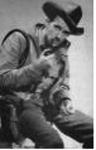
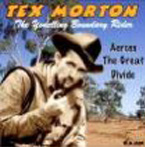
The railway employed 'railway police' who tried to clear the free travellers but they were never entirely successful being outnumbered thousands to one. Some were known for their officious nature. Sergeant Small, the subject of a song performed by the great Tex Morton in the late 1930s was such a man.
When the recording was released commercially Small instigated legal action and the song was removed from sale with an apology.
SERGEANT SMALL
I went broke in Western Queensland in 1931,
Nobody would employ me so my swaggie days begun.
I headed out through Charleville to the western towns,
I was on my way to Roma, destination Darling Downs.
Hey my pants were getting ragged, my shoes were getting thin,
And when we stopped at Mitchell, a goods train shunted in,
The engine blew her whistle, I was looking I could see,
She was on her way to Roma, that was very plain to me.
And I wish that I was 16 stone and only 7 foot tall,
I'd go back to Western Queensland and beat up Sergeant Small.
Well as I sat and watched her, inspiration seemed to grow,
And I remember the Government slogan,
"It's the railway that you own."
So by this time the sun was setting and night was growing nigh,
So I gathered my belongings and I caught her on the fly.
And as we came into Roma, I kept my head down low,
I heard a voice say "any room mate" and I answered "plenty 'bro'!"
Then out there stepped this noble man, the voice of Sergeant Small,
He said I've trapped you very nicely, you're headed for a fall.
And I wish that I was 16 stone and only 7 foot tall,
I'd go back to Western Queensland and beat up Sergeant Small.
The judge was very kind to me, he gave me 30 days,
He said maybe that would help to cure my rattler jumping ways.
So if you're down and outback let me tell you what I think,
Just stay off the Queensland railway, it's a short cut to the clink.
And I wish that I was 16 stone and only 7 foot tall,
I'd go back to Western Queensland and beat up Sergeant Small,
I'd go back to Western Queensland and beat up Sergeant Small.
|
|
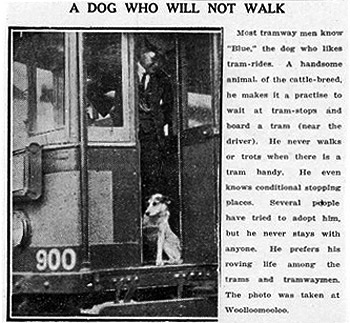
BOB THE RAILWAY DOG
In the 1890s the SA railways had their own dog. It was believed to be the pet of a deceased driver and it retained its nickname of bob the dog. A traveler had a special collar inscribed: 'Stop me not but let me jog, I am Bob the driver's dog' Bob had a habit of jumping onto the footplates. (Quoted Patsy Adam Smith Outback Heroes)
|
|
|
In 1917 Australia experienced one of its worst-ever strikes. Once again the bitter conflict between worker and master erupted. The strike, which started in Sydney over what we would now refer to as a 'time and motion study', eventually spread right throughout the railway, then to allied unions and then interstate. At the height of the strike the railway requested Sydney schoolboys to assist as volunteer labour.
|
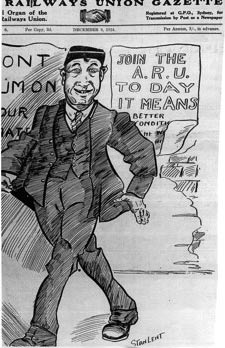 Join the Australian Railway Union
 |
THE NEW EXHIBITS
(Tune 'Road to Gundagai' suggested by Warren Fahey 2005)
'Say, what are these exhibits called?', the monkey asked her mate -
'Those bipeds that the keeper has admitted through the gate,
A longing undeniable the problem to discuss
Have I - oh, tell me what they are, who come to live with us?'.
'Your question is a poser, and my answer's Humpty Do,
For likewise I am puzzled much', said monkey Number two.
'I've eyed them up and I've eyed them down, I've viewed them near and far-
But twist my tail if I can guess what brand of beast they are'.
Then went the Ape inquisitive, behind a pile of rocks,
And put her question to a seer, to wit the ancient fox.
'Oh Mr. Fox' the monkey asked, 'I come to learn from you,
Particulars concerning those new tenants at the zoo'.
The Fox he wunk a knowing wink, peculiar to seers,
'Oh they,' he said, 'are what are called, the rural volunteers.'
'God gave to them a backbone each (but right against their wish) -
They much prefer to emulate the spineless jelly-fish!'
'God gave them strength with which to help the weak who call for aid -
It was, I think, the one mistake that ever heaven made!'
And curious folk they are at best- the cuss'edest of all:
God gave them legs—and-yet —how strange!—they each prefer to crawl'.
'God gave them eyes with which to see but bitter facts remind
My comprehension stubbornly that most of them are blind!
God gave them each a brain to use—but—this you wouldn't guess -
They get their thinking done for them by 'Bulging Belly's Press'.
'I thank you much,' the monkey said, 'I felt most strangely queer
As though impelled to vomiting whenever they came near.
It isn't fair to our good name, to either fox or ape-
So when the night enfolds the Zoo I'm making my escape!'
(By R.J. Cassidy, 1917)
|


|